
Beyond the Red Pill: Mapping The Matrix Through Ken Wilber’s Integral Lens
After publishing my recent blog post on The Matrix and the cycle of thought, feeling, action, and creation, I was struck by the range of responses it triggered. Some people responded with political commentary, others with deeply spiritual reflections, while some couldn’t move beyond its sci-fi surface. What fascinated me was not the content of their responses, but what those responses revealed.
Much like the film itself, the reactions became a mirror—a living demonstration of one of The Matrix‘s central insights: we each perceive reality based on where we’re looking from. And this is exactly where Ken Wilber’s Integral Theory becomes a potent tool for deeper understanding.
The Matrix as Developmental Allegory
Wilber maps human development through a series of increasingly complex worldviews—stages of consciousness that evolve over time. Each stage shapes how we see reality and what we value. To make this more accessible, Wilber often uses colors to represent each level, but let’s stay with plain language while noting that the spectrum moves from instinct and survival to unity and transcendence.
In The Matrix, we can trace Neo’s journey—and the world around him—through these stages:
We begin with the dreamers, those still plugged into the Matrix. Their lives are driven by inherited beliefs and the pursuit of safety, pleasure, and material comfort. This is the pre-rational or mythic stage, where truth is less important than familiarity. Cypher embodies this vividly—choosing the illusion of a juicy steak over the burden of knowing what’s real. He doesn’t care that the steak isn’t real. He just wants to feel good.
Neo, before his awakening, is skeptical but complicit. As Thomas Anderson, he’s a software programmer who senses something’s wrong. He’s in the rational modern mindset—questioning, curious, tech-savvy. This stage values facts, independence, and logic, but still operates within the system’s rules.
When Neo meets Morpheus and Trinity, he’s introduced to a new lens. The resistance represents the postmodern view—deeply aware of systems of control, emotionally invested, open to subjectivity and alternative truths. They challenge authority and offer Neo something powerful: choice. But this stage can linger in resistance, in pointing out the flaws without yet transcending them.
Neo’s transformation into The One takes us into the integral stage. Here, the boundaries between mind and matter soften. He no longer needs to dodge bullets—he simply sees that bullets are constructs. Reality becomes fluid. He embodies mastery—not by rejecting the Matrix, but by moving through it with clarity. This is a level where all previous truths are included, but not limited by.
And finally, in the later films, we glimpse something beyond even that: a transpersonal view. Unity. Flow. A place beyond duality. It’s no longer about waking up from a system. It’s about becoming lucid within the dream itself. Awareness not as an escape, but as integration.
Lana Wachowski, in reflecting on her creative process, once said: “Art is a return to the unspeakable, the inarticulable. It’s a chance to touch something that exists beneath language, beneath structure.” This perfectly captures the depth the films were reaching for—The Matrix was never just about the machines. It was about the human condition, our cycles of meaning-making, and the subtle architecture of consciousness.
In another conversation, she described The Matrix as an exploration of transformation: “The idea of transformation is at the heart of the story… it’s about all of us having the capacity to change, to wake up, to see differently.” That’s precisely what the Integral lens invites us to do.
Why This Matters
Your reaction to The Matrix likely says more about your current lens on reality than the film itself. And that’s not a judgment—it’s a map. Each stage offers gifts and limitations. The power lies not in being at the “top,” but in knowing where you are, and where you’re growing.
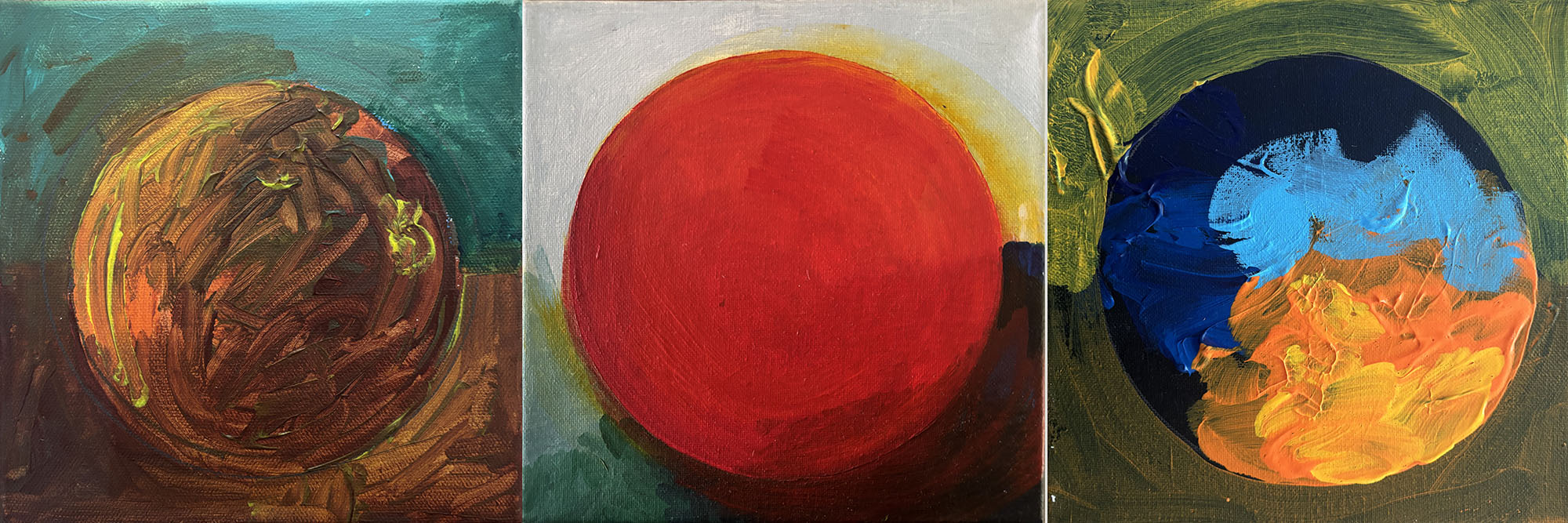
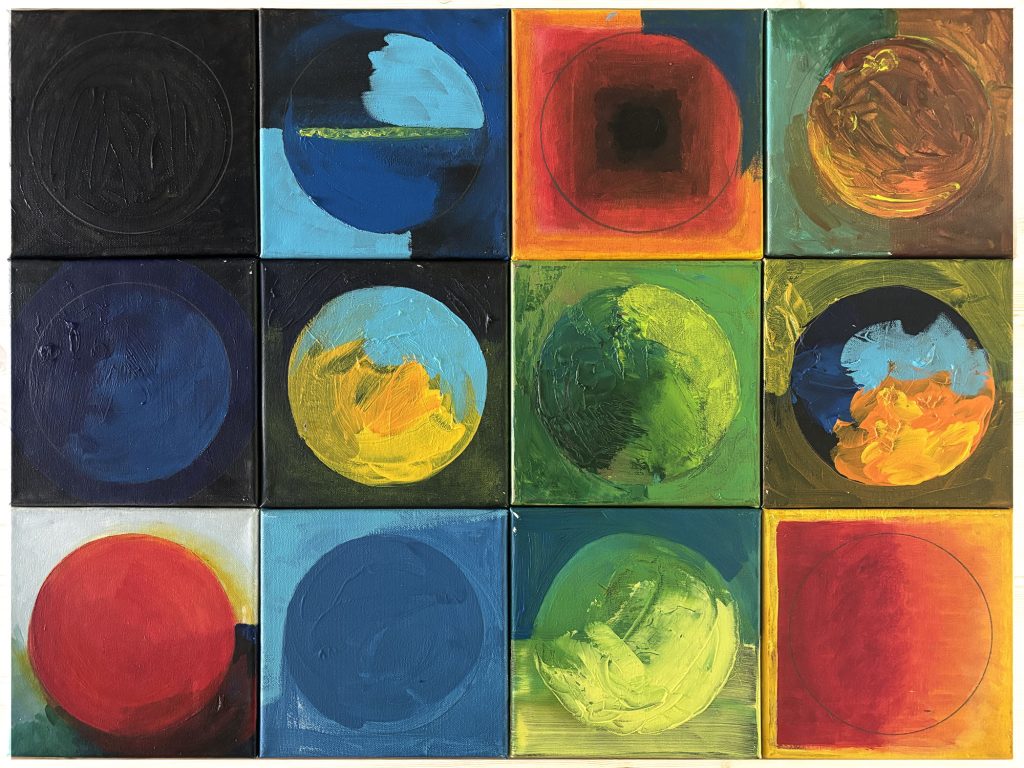
As an artist drawn to circles—literal and metaphorical—I see this not as a trap but as a spiral. Each loop of thought, feeling, action, and form can either reinforce old patterns or evolve us. The key is awareness. A pause. A moment to choose again.
That’s the real red pill. Not escape. Not rebellion. But authorship.
Let’s keep spiraling.
Footnotes
- Integral Theory is a meta-framework that seeks to include and integrate all perspectives—inner and outer, individual and collective, developmental and experiential. It suggests that human consciousness evolves through recognizable stages, and that true understanding arises when we learn to see through multiple lenses simultaneously.
- Ken Wilber is an American philosopher and author best known for developing Integral Theory, a framework that synthesizes insights from psychology, spirituality, science, and systems theory. His work maps human development across multiple dimensions, encouraging holistic, evolutionary thinking.
- Lana Wachowski is a filmmaker and writer, co-creator of The Matrix film series alongside her sister Lilly Wachowski. Her work often explores themes of identity, transformation, and liberation. Lana has described The Matrix as a metaphor for personal awakening and the possibility of inner change.
Observations_Lunariacja* on States Of Mind, acrylic paint on canvas 81cm x 61cm
If you wish to purchase any of my work or sponsor me, please get in touch directly.
I’ll walk you through the next steps. And I’ll do it with gratitude—and fire.
📧 maria@maria-agni-art.com
📞 +44 (7)552 145 680
With love and ink-stained fingers,
Maria Agni
Explore & connect
🖼️ View my work: maria-agni-art.com
📷 Follow along on Instagram: @maria_agni_art
📬 Join my mailing list for updates, studio notes, and upcoming shows
💌 Reach out for inquiries, collaborations, or conversation:
*Lunariacja [loo-nah-ree-AHT-syah]
noun · feminine · poetic neologismDefinition:
A state of moon-induced variation; the lucid unraveling of the self into multiple, dream-like expressions.
A lyrical descent into poetic madness, where logic is dissolved under lunar light and identity dances in shifting forms.
Derived from lunatic and Polish wariacje (variations), with etymological echoes of wariat (madman).


Leave a Reply